

What You’ll Learn:
- The four-generation ownership history behind the Owen Magic Supreme name
- Why Owen apparatus earned its reputation as the standard for fine craftsmanship
- The materials and construction details that separate genuine Owen pieces from lookalikes
- What the company’s current for-sale status means for collectors right now
- How to evaluate an Owen piece before you buy
📅 Updated: August
✍️ Author Expertise: Magic Trick Collector, Curator, and Steward of History
Owen Magic Supreme: A Name Built Across Four Owners
Owen Magic Supreme is one of the most respected names in fine magic apparatus, and the brand didn’t start under that name. The story begins in August 1902, when Floyd Thayer placed his first advertisement offering a trick called the “Wand of the West.” That small ad grew into the Thayer Magic Company, one of the most respected names in early 20th-century American magic manufacturing.
Carl Owen joined the firm in 1913, and his brother Emmett followed later. In 1933, Floyd Thayer split the business into two separate companies: Thayer Manufacturing and Thayer Studio. The Owen brothers purchased Thayer Manufacturing and kept building on the foundation Thayer had laid. Along the way, they absorbed other companies, including Merv Taylor Magic, steadily expanding what the Owen name stood for.
The company changed hands again in 1963, when Les and Gertrude Smith acquired Owen Magic Supreme. Under their stewardship, the business moved to Azusa, California in 1978, where it became a fixture of the magic world for decades, known globally by performers, film and television production, and collectors alike.
Why Owen Magic Supreme Is “The King of the Hill”
That’s not just marketing language. Among serious collectors, Owen Magic Supreme has long carried a reputation few other manufacturers can match: to own a genuine Owen piece is considered owning some of the finest apparatus magic has produced. That standing comes from decades of consistent, meticulous craftsmanship rather than any single famous trick.
Owen apparatus has a documented history with some of magic’s most recognizable names. The company built illusions and effects used by performers including Harry Blackstone Sr., Dante, and Doug Henning, and its work has appeared behind the scenes in film, television, and stage productions for close to a century. That performer pedigree, combined with the company’s own retail reputation, is a big part of why Owen pieces command real attention in the secondary market today.
What to Look For: Materials and Construction
Owen apparatus is instantly recognizable to anyone who has handled a genuine piece, but the details matter if you’re buying without that hands-on reference point.
- Fine hardwoods: Owen pieces are commonly built from exotic woods including Purple Heart, Bubinga, Padauk, and Maple, often finished to a furniture-grade standard rather than a utilitarian one.
- The “Owen Genie” mark: Later production pieces carry a laser-etched Owen Genie logo, a reliable authenticity signal on more recent apparatus. Earlier pieces predate this mark, so its absence alone doesn’t rule out authenticity on an older item.
- Metal component quality: Owen’s precision utility items, like their card trimmers and coin wands, use bronze, brass, and tool steel construction, with attention to fit and finish that’s difficult for reproductions to match.
- Hand-finished surfaces: Many pieces, especially wood-turned items like ball vases and pill boxes, were hand-turned by Les Smith himself, giving individual pieces subtle, non-uniform character that mass production doesn’t replicate.
If you’re evaluating a piece described as Owen Magic Supreme but it lacks the weight, finish quality, and construction precision described above, treat that as a reason to ask more questions about its origin before assuming authenticity.
Signature Owen Magic Supreme Pieces Collectors Look For
Certain effects have become closely associated with the Owen Magic Supreme name over the decades:
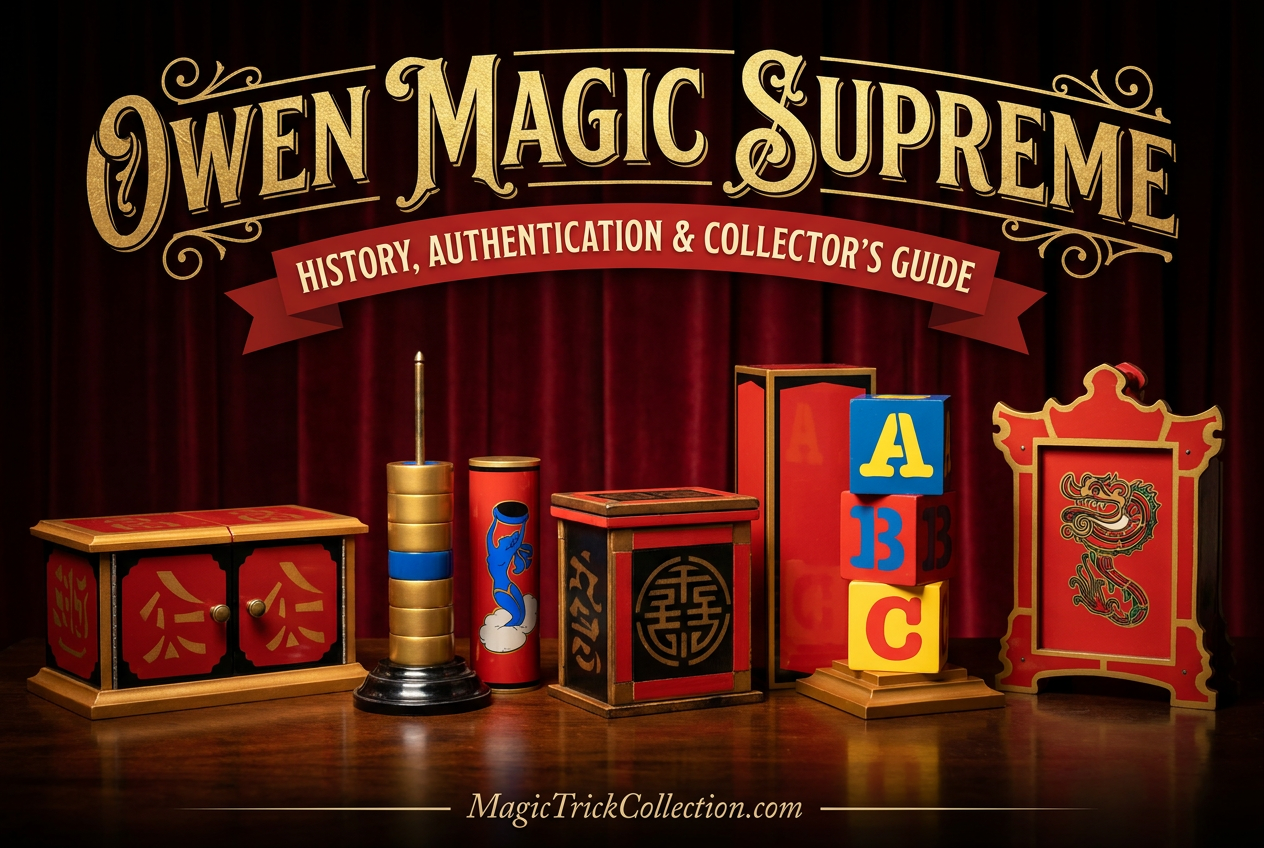
- The Square Circle — one of magic’s genuine classics, produced by Owen in multiple sizes and considered a benchmark version of the effect
- The Blue Phantom — a precision mechanical checker-stack illusion, especially sought after in its early 1970s form
- The Absent-Minded Rabbit — a scarce classic that’s become harder to find as original stock has thinned
- Coin wands and card trimmers — Owen’s precision utility pieces, prized by collectors as much for engineering as performance value
These aren’t the only collectible Owen pieces by any means, but they’re a reasonable starting point if you’re building a collection and want examples with strong name recognition and established demand.
What “For Sale” Means for Collectors Right Now
Here’s where Owen Magic Supreme’s story takes a turn worth understanding clearly, because it directly affects how you should think about buying. The Azusa, California retail storefront that had operated for more than a century closed in 2020, a casualty of the pandemic’s impact on live entertainment and foot traffic. That didn’t end the company outright — Owen Magic Supreme has continued operating in a smaller footprint since, currently based out of La Verne, California under owner Alan Zagorsky.
As of mid-2026, the company’s own website carries a direct announcement: Owen Magic is currently for sale, with ownership actively looking for someone to, in their words, “keep the wheels turning.” That’s a meaningfully different situation than a company that has simply shut down, and it’s also different from one operating with certainty about its future. It’s a business in transition, with real uncertainty about what happens next.
For collectors, that uncertainty is worth taking seriously rather than reacting to with urgency-driven buying. A pending sale could mean the brand continues under new ownership, continues in a reduced capacity, or eventually winds down entirely — nobody outside the transaction knows yet. What is clear is that existing Owen apparatus, especially older pieces from the Thayer-Owen and early Smith eras, represents decades of production that won’t be replicated by any new owner, regardless of how the sale resolves.
Owen Compared to Other Premium Makers
Collectors researching Owen often end up comparing it to Mel Babcock’s work, another name associated with fine wood construction and meticulous craftsmanship. The comparison is a fair one, but the two represent different traditions. Babcock built primarily from his own small workshop in Cashmere, Washington, working largely alone across a roughly 40-year career that ended with his 2023 retirement. Owen, by contrast, has operated as an actual manufacturing company across more than a century, with a production scale, catalog breadth, and performer client list that a single craftsman’s workshop couldn’t match.
That difference shows up in what each maker is known for. Babcock’s reputation centers on a small number of signature effects, particularly his die boxes, refined obsessively over decades. Owen’s reputation rests on range: illusions, close-up utility items, stage apparatus, and everything in between, all built to a consistent standard across generations of different craftsmen working under the same name. Neither approach is more legitimate than the other — they simply represent different models of how “fine magic apparatus” gets made, and serious collectors often end up owning examples of both.
What to Check Before You Buy
Because Owen’s production spans over a century and multiple ownership eras, condition and era verification matter more than with a single-maker workshop. Before buying:
- Confirm which era the piece is likely from — Thayer-Owen (pre-1963), early Smith era, or later Smith-era production — since construction details and materials shifted somewhat across decades
- Check for the laser-etched Owen Genie mark on pieces that would plausibly carry one; its presence helps place a piece in later production, though its absence doesn’t disqualify an earlier item
- Inspect joinery and hardware for consistency with the wood types and finish quality described above — replacement parts or refinishing should be disclosed by the seller, not something you discover after purchase
- For mechanical pieces, confirm the mechanism still operates smoothly; Owen’s reputation rests partly on precision engineering, and a sticking or misaligned mechanism is a real defect, not just cosmetic wear
- Ask for documentation or provenance where available, particularly for pieces claimed to have performer history, since that kind of claim benefits from more than a seller’s word
Buying With Confidence
Owen Magic Supreme’s ownership history is genuinely unusual: four distinct eras, from Thayer’s founding through the Owen brothers to Les and Gertrude Smith’s decades-long stewardship, and now a company facing an uncertain next chapter. That continuity of craftsmanship across ownership changes is a big part of what makes the name mean something to collectors in the first place.
If you’re adding Owen pieces to a collection, prioritize documented construction quality, the materials and finish described above, and where possible, a clear production era. Given the company’s current transitional status, don’t assume you can simply order a replacement or reissue later — much of what’s available now reflects decades of a specific production history that may not continue in the same form.
Resource: Owen Magic Trick Collection
Frequently Asked Questions


