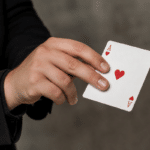
Few things look cooler than a playing card slicing through the air with speed, spin, and purpose. It feels part magic trick, part martial art, and part carnival stunt. For magicians, knowing how to throw a playing card is more than a flashy skill. It can become a memorable opener, a dramatic closer, or a visual moment that makes spectators lean in and say, “Wait—how did you do that?”
The art of throwing playing cards became strongly associated with legendary magician, author, actor, and magic historian Ricky Jay, whose 1977 book Cards as Weapons helped turn card throwing into a cult fascination within the magic world. Indiana University’s Lilly Library notes that Cards as Weapons became Jay’s first published book in 1977, after which he wrote many more works on magic, unusual performers, and historical curiosities.
This guide explains how to throw a playing card safely, what cards work best, and how magicians can use card throwing as a performance piece instead of a random stunt.
Why How to Throw a Playing Card Belongs in Magic
Card throwing has a natural connection to the magic industry because playing cards already carry mystery. A deck is one of the most familiar objects in the world, yet in a magician’s hands it becomes impossible, theatrical, and deceptive.
For a magician, knowing how to throw a playing card can create:
A visual surprise before a card routine
A way to reveal a selected card
A dramatic stage moment
A skill-based demonstration
A connection to classic magic history
Ricky Jay helped elevate card throwing from a sideshow curiosity into part of magic culture. He was not merely a performer who threw cards. He was also a serious historian of deception, gambling, con games, and unusual entertainers. The New Yorker profiled Jay as a master sleight-of-hand artist and scholar whose work included Cards as Weapons and Learned Pigs & Fireproof Women.
Learn how to throw a playing card like a magician, matters because card throwing should not feel like a cheap gag. Done well, it feels like controlled skill. It gives your magic a sharper edge.
Why How to Throw a Playing Card Safety First: Throw Cards Responsibly
Before learning the technique, understand this clearly: a thrown playing card can sting, scratch, or damage fragile objects. Practice only in a safe area.
Use:
A soft cardboard box
Foam board
A hanging towel
A cork board
A safe open space
Do not throw cards at people, pets, glass, screens, artwork, or anything valuable.
For magicians, the goal is theatrical control, not injury. Your audience should feel impressed, not nervous.
The Best Playing Cards to Use
Not every deck throws the same. Thin, flimsy novelty cards often wobble. Plastic cards may last longer, but they can feel slippery. For most magicians, quality paper playing cards with a good finish work best.
1. Bicycle Rider Back Playing Cards
Bicycle cards are the standard deck most spectators recognize. That makes them excellent for magic because they look ordinary. Bicycle’s own site describes its cards as suitable for games, magic, and collecting.
For card throwing, Bicycle cards are a strong starting point because they are affordable, widely available, and easy to replace.
Best for: beginners, close-up magicians, general practice.
2. Bee Playing Cards
Bee cards are known for durability and a casino-style borderless back design. Vanishing Inc describes Bee Playing Cards as a high-quality, affordable deck manufactured by USPCC on premium flexible stock.
The flexible stock can help when practicing snap and release. However, the borderless design may make them less ideal for certain magic tricks where hidden orientation matters.
Best for: practice, gambling demonstrations, strong handling.
3. Tally-Ho Playing Cards
Tally-Ho decks are popular among magicians because of their smooth handling and classic look. Many magicians like them for flourishes, sleights, and elegant card work.
Best for: magicians who want a slightly more refined deck feel.
4. Practice Decks and Old Decks
You do not need to destroy premium decks while learning. Start with older decks that still have decent stiffness. If the cards are warped, sticky, or limp, they will not fly cleanly.
Best for: early practice and repetition.
What Makes a Good Throwing Card?
A good card for throwing should have:
Firm stock
Clean edges
Smooth finish
No bends or creases
Enough stiffness to hold shape in flight
Card throwing depends on spin. The spin stabilizes the card, much like a frisbee. Without spin, the card flutters. With spin, it cuts through the air.
How to Throw a Playing Card
Step 1: Hold the Card Correctly
Start with one card. Hold it at one corner between your index finger and middle finger. Your thumb should help stabilize the card.
A common grip:
Place the card horizontally.
Grip the lower corner with your index and middle fingers.
Keep your thumb lightly against the card.
Let most of the card extend away from your hand.
Do not squeeze too tightly. A tense grip slows the release.
Step 2: Load the Wrist
Bring your hand slightly inward toward your body. Your wrist should bend back a little, like you are preparing to flick water off your fingers.
The power does not come from your shoulder. It comes mainly from the wrist and fingers.
Think snap, not shove.
Step 3: Aim at a Safe Target
Use a cardboard box or foam board placed several feet away. At first, stand close. Five to seven feet is enough.
Do not try to throw across the room immediately. Accuracy comes before distance.
Step 4: Flick and Release
Snap your wrist forward and let the card roll off your fingers. The goal is to create fast spin.
The card should leave your hand flat, not tilted upward like a paper airplane.
A clean throw feels quick and light. You should not feel like you are forcing it.
Step 5: Follow Through
Let your hand continue forward naturally. Do not stop your wrist too soon. A stiff stop can ruin the release.
If the card wobbles, you need more spin.
If the card dives downward, your angle may be too low.
If the card sails upward, your wrist may be lifting at release.
Common Beginner Mistakes When Learning How to Throw a Playing Card
Mistake 1: Throwing with the Arm
Beginners often swing the whole arm. This creates speed but not control. Card throwing relies on wrist snap and rotation.
Mistake 2: Holding the Card Too Deep
If too much of the card sits inside your grip, it cannot spin freely. Hold the corner, not the whole card.
Mistake 3: Using Damaged Cards
Bent cards wobble. Sticky cards drag. Soft cards flop.
Use clean, firm cards.
Mistake 4: Practicing Too Far Away
Distance is earned. Start close. Build accuracy first.
A Simple Practice Routine for How to Throw a Playing Card
Use this 10-minute routine:
Minute 1–2: Practice the grip without throwing. Minute 3–5: Throw at a large cardboard target from five feet away. Minute 6–8: Focus only on spin. Ignore power. Minute 9: Try to hit one specific area of the target. Minute 10: End with five slow, controlled throws.
Practice daily for short sessions. Long sessions can strain your wrist and teach bad habits.
How Magicians Can Use Card Throwing in Performance
Card throwing should serve the act. It should not feel random.
Here are practical ways to use it.
1. The Card Reveal
Have a spectator select a card. Control it to the top of the deck. Then throw the top card toward a soft target where it lands face out.
This creates a dramatic reveal.
2. The Opening Stunt
Walk onstage, remove one card, and throw it into a target. Then say:
“Most people shuffle cards. Magicians weaponize attention.”
That line frames the routine with personality.
3. The Collector Angle
For a vintage magic audience, connect card throwing to magic history. Mention Ricky Jay, gambling demonstrations, carnival skills, and the long tradition of magicians turning everyday objects into impossible tools.
4. The Comedy Version
Throw a card weakly on purpose. Let it flop. Pause. Look at the audience and say:
“That was the warning shot.”
Then perform the real throw.
Ricky Jay and the Legacy of Card Throwing
Ricky Jay’s influence matters because he gave card throwing character. His book Cards as Weapons treated the idea with theatrical exaggeration, wit, and historical flavor. Amazon’s listing describes the book as a parody of self-defense books showing how ordinary playing cards could be used as a means of protection.
That playful seriousness is exactly what makes the subject work for magicians. It is absurd, but it is also skillful. It is funny, but it is also impressive.
Jay understood that magic is not only about secrets. It is about framing. A simple object becomes fascinating when the performer gives it a story.
Recommended Cards for Different Magicians
Performer Type
Recommended Deck
Why It Works
Beginner magician
Bicycle Rider Back
Affordable, familiar, easy to replace
Serious card worker
Tally-Ho
Smooth handling and classic magician appeal
Gambling demo performer
Bee
Casino-style look and durable feel
Collector-performer
Limited Bicycle or vintage-style decks
Adds visual character
Practice-heavy performer
Older USPCC decks
Good for repetition without wasting premium decks
Vanishing Inc notes that Bicycle Rider Back decks from USPCC avoid some of the unprofessional stickers or advertisements found on certain standard retail boxes, which can matter to magicians who want a cleaner professional look.
How to Throw a Playing Card – Final Tips for Better Card Throws
Keep your throws flat.
Use your wrist.
Create spin first, speed second.
Practice with one deck consistently.
Replace damaged cards.
Build a routine around the skill.
And most importantly, make it entertaining.
A playing card thrown across a room is a stunt. A playing card thrown with timing, history, humor, and purpose becomes magic.
Conclusion
Learning how to throw a playing card gives magicians another way to turn an ordinary deck into a moment of surprise. The move is visual, affordable, and deeply tied to the culture of card magic. With the right grip, enough spin, safe practice, and a quality deck from brands like Bicycle, Bee, or Tally-Ho, you can build a skill that fits close-up magic, stage magic, comedy, or collector-themed presentations.
Ricky Jay showed that card throwing could be more than a trick. It could be a story. For today’s magician, that is the real lesson.
Do not just throw the card.
Throw the moment.
Frequently Asked Questions
How can I learn to throw a playing card like a magician?+
To learn to throw a playing card like a magician, start by practicing the correct grip, loading your wrist for a snap motion, and aiming at a safe target. Focus on creating spin for stability and accuracy.
What are the best playing cards for throwing?+
The best playing cards for throwing include Bicycle Rider Back cards for beginners, Bee Playing Cards for durability, and Tally-Ho Playing Cards for smooth handling. Quality paper cards with a good finish are recommended.
What common mistakes should I avoid when throwing playing cards?+
Common mistakes include throwing with your arm instead of using your wrist, holding the card too deeply, using damaged cards, and practicing from too far away. Focus on control and precision.
How can I incorporate card throwing into my magic performance?+
You can incorporate card throwing into your magic performance by using it for dramatic reveals, as an opening stunt, or connecting it to the history of magic. Make it part of your act rather than a random trick.
Who is Ricky Jay and why is he important in card throwing?+
Ricky Jay was a legendary magician and historian who elevated card throwing to an art form. His book 'Cards as Weapons' showcased the skill with theatrical flair, influencing how magicians use card throwing in performances.
Steven WarburtonMagic Trick Collector, Curator, and Steward of History
Magic Collector, Magician, Escape Artist, Archivist. As a former practicing magician and escape artist, Steven Warburton has spent more than four decades as a dedicated magic collector.
Contains information related to marketing campaigns of the user. These are shared with Google AdWords / Google Ads when the Google Ads and Google Analytics accounts are linked together.
90 days
__utma
ID used to identify users and sessions
2 years after last activity
__utmt
Used to monitor number of Google Analytics server requests
10 minutes
__utmb
Used to distinguish new sessions and visits. This cookie is set when the GA.js javascript library is loaded and there is no existing __utmb cookie. The cookie is updated every time data is sent to the Google Analytics server.
30 minutes after last activity
__utmc
Used only with old Urchin versions of Google Analytics and not with GA.js. Was used to distinguish between new sessions and visits at the end of a session.
End of session (browser)
__utmz
Contains information about the traffic source or campaign that directed user to the website. The cookie is set when the GA.js javascript is loaded and updated when data is sent to the Google Anaytics server
6 months after last activity
__utmv
Contains custom information set by the web developer via the _setCustomVar method in Google Analytics. This cookie is updated every time new data is sent to the Google Analytics server.
2 years after last activity
__utmx
Used to determine whether a user is included in an A / B or Multivariate test.
18 months
_ga
ID used to identify users
2 years
_gali
Used by Google Analytics to determine which links on a page are being clicked
30 seconds
_ga_
ID used to identify users
2 years
_gid
ID used to identify users for 24 hours after last activity
24 hours
_gat
Used to monitor number of Google Analytics server requests when using Google Tag Manager
1 minute
SourceBuster is used by WooCommerce for order attribution based on user source.
Name
Description
Duration
sbjs_current
Traffic origin information for the visitor’s current visit to your store
session
sbjs_first_add
Timestamp, referring URL, and entry page for your visitor’s first visit to your store (only applicable if the visitor returns before the session expires)
session
sbjs_current_add
Timestamp, referring URL, and entry page for your visitor’s current visit to your store
session
sbjs_migrations
Technical data to help with migrations between different versions of the tracking feature
session
sbjs_session
The number of page views in this session and the current page path
30 minutes
sbjs_udata
Information about the visitor’s user agent, such as IP, the browser, and the device type
session
sbjs_first
Traffic origin information for the visitor’s first visit to your store (only applicable if the visitor returns before the session expires)
session
Marketing cookies are used to follow visitors to websites. The intention is to show ads that are relevant and engaging to the individual user.
Pinterest Tag is a web analytics service that tracks and reports website traffic.