

📋 What You’ll Learn
In this comprehensive guide about Abbott’s Magic collectibles, we’ve compiled everything you need to know. Here’s what this covers:
- How Abbott’s Magic began and developed in Colon, Michigan
- Why Abbott’s became important to American magic manufacturing
- How the Abbott’s Magic Get-Together influenced the magic community
- Which types of Abbott’s props attract collectors
- Why stage and platform apparatus remains especially desirable
- How catalogs, instructions, and printed materials add historical value
- Which factors influence collectibility and potential market value
- How to evaluate condition, completeness, and performance potential
- Practical ways to build a focused Abbott’s Magic collection
- How to care for, store, display, and preserve vintage apparatus
- What to consider when purchasing Abbott’s collectibles online
- Why Abbott’s Magic continues to hold lasting appeal among magicians and collectors
Abbott’s Magic Collectibles: History, Props and Collector Guide
For generations of magicians, the name Abbott’s Magic has represented far more than a magic dealer. It recalls colorful catalogs, imaginative stage apparatus, carefully constructed wooden props, annual gatherings of magicians, and the excitement of discovering a new effect that could transform a performance.
Today, Abbott’s Magic collectibles remain highly appealing to magicians, historians, and collectors of vintage magic apparatus. Some collectors seek elaborate stage effects. Others prefer smaller mechanical tricks, early catalogs, instruction sheets, advertising materials, or props connected to a particular performer.
Regardless of the category, Abbott’s pieces preserve an important chapter of American magic history.
For collectors, that connection creates much of the attraction. An Abbott’s prop may represent the development of a classic effect, the working methods of an earlier magician, or the craftsmanship of an era when magic apparatus was frequently built by hand.
The Beginning of Abbott’s Magic
The Abbott Magic Company was established in Colon, Michigan, in 1934 by magician Percy Abbott. Soon afterward, Recil Bordner joined the company as Abbott’s business partner.
Their partnership helped create one of the most influential magic businesses in the United States.
According to Abbott’s official company history, Percy Abbott opened the shop above a grocery store in January 1934. Recil Bordner joined him several months later after purchasing a half interest in the business. Together, they began expanding the company and building its reputation among working magicians.
The company eventually became closely connected with Colon’s identity as the Magic Capital of the World.
Abbott’s did more than sell tricks. It manufactured apparatus, published instructional material, maintained relationships with professional performers, and helped create a lasting community around the art of magic.
The Abbott’s Magic Get-Together
One of Abbott’s most important contributions is the annual Abbott’s Magic Get-Together.
The event began in 1934 as an open house designed to bring magicians together and introduce them to the company’s products. The response encouraged Abbott and Bordner to continue the gathering. Over time, it developed into one of magic’s longest-running conventions.
The Get-Together strengthened Abbott’s position within the magic community. It also helped turn Colon, Michigan, into a destination for magicians from across the United States and around the world.
For many attendees, the experience included:
- Stage performances
- Lectures and demonstrations
- Dealer displays
- Magic auctions
- Conversations with builders and performers
- Opportunities to purchase new and vintage apparatus
The gathering became part convention, part reunion, and part celebration of magic history.
Consequently, Abbott’s collectibles often carry an emotional connection that extends beyond the physical prop. A magician may remember seeing an effect demonstrated in Colon, purchasing it from the Abbott’s showroom, or discovering it in a catalog during childhood.
Why Abbott’s Magic Collectibles Matter
Abbott’s occupies a distinctive place in magic collecting because the company served several generations of performers.
Its products ranged from accessible tricks for developing magicians to substantial stage apparatus intended for professional presentation. Abbott’s also distributed books, manuscripts, silks, livestock effects, comedy props, production equipment, cabinets, tables, and larger illusions.
This broad catalog gives collectors many ways to approach the brand.
Some build collections around a specific period. Others search for a particular apparatus category. Still others collect anything associated with Abbott’s history, Colon, Percy Abbott, Recil Bordner, or the annual Get-Together.
Abbott’s collectibles matter because they preserve three connected histories:
- The history of American magic manufacturing
- The working history of individual magicians
- The cultural history of Colon, Michigan
A vintage prop can therefore be appreciated as a performance tool, decorative object, mechanical invention, or historical artifact.
The Appeal of Abbott’s Magic Collectibles Craftsmanship
Many Abbott’s props have a recognizable theatrical character.
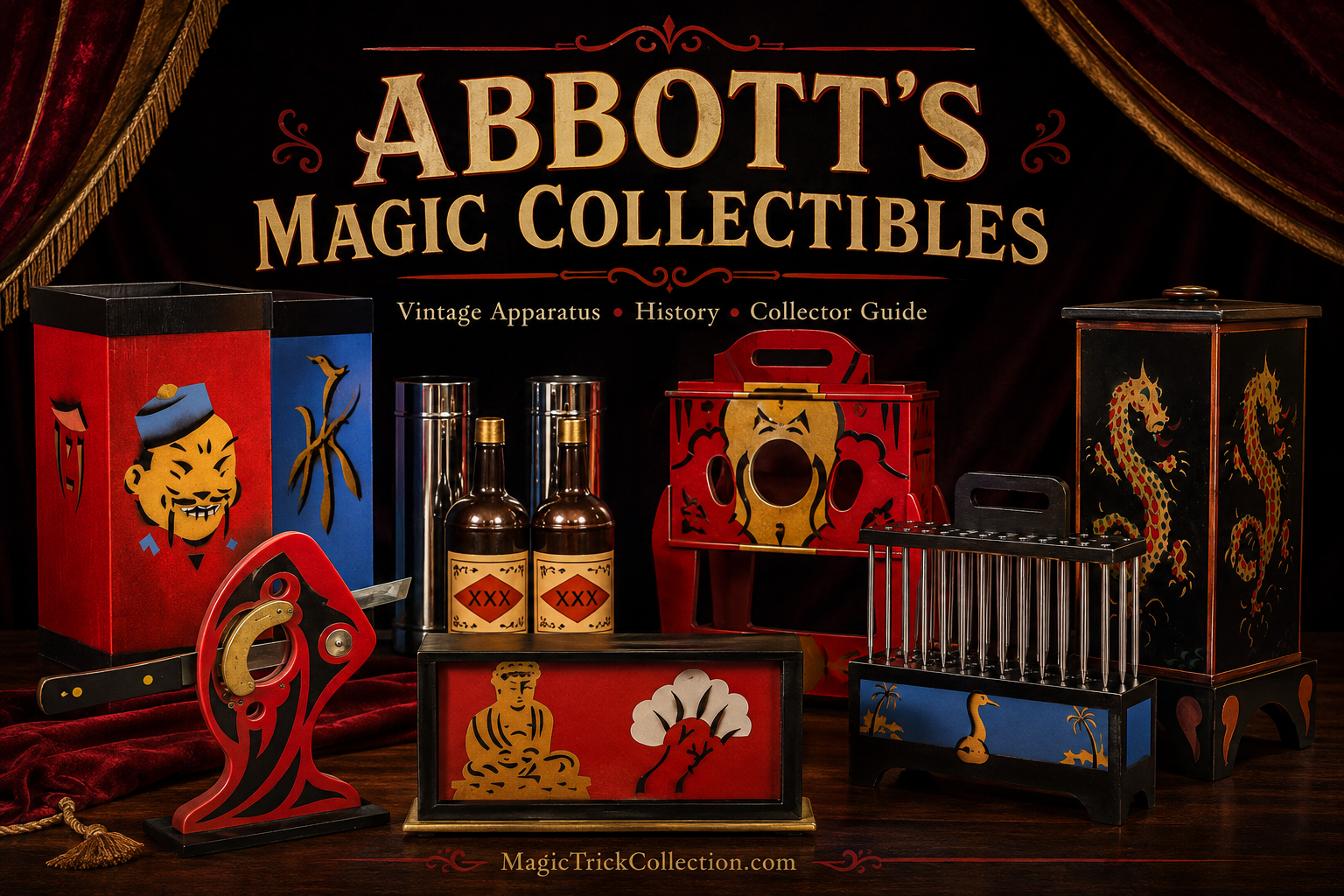
Their visual design often relied on bold colors, painted graphics, decorative trim, metal fittings, and strong geometric forms. These features allowed the apparatus to remain visible during platform and stage performances.
The goal was not always subtlety. Abbott’s frequently created props that looked like magic apparatus. They were colorful, intriguing, and designed to capture attention.
Wood was commonly used for cabinets, boxes, stands, tubes, and production equipment. Metal components supported moving parts, doors, hinges, catches, and secret mechanisms. Fabric, rope, glass, paper, and other materials were incorporated depending on the effect.
Because much of this apparatus was built for active performance, surviving examples frequently show evidence of use. Small scratches, paint loss, replaced handles, worn interiors, and minor repairs may reflect years of service rather than neglect.
For many magic trick collectors or rare & vintage magic tricks, those signs of use contribute to the prop’s character.
Stage and Platform Magic
Abbott’s became especially well known for stage and platform apparatus.
These pieces were designed for performances in theaters, schools, clubs, banquet rooms, churches, auditoriums, and community halls. They needed to be visible from a distance, practical to transport, and dependable during repeated use.
This category may include:
- Production boxes
- Vanishing apparatus
- Livestock effects
- Silk magic
- Die boxes
- Comedy props
- Transformation effects
- Penetration effects
- Decorative tables and stands
- Larger cabinets and illusions
Stage apparatus often attracts serious magic collectors because it displays so well. A colorful Abbott’s prop can become the visual centerpiece of a magic room, library, office, or private museum.
Moreover, larger apparatus tends to survive in lower quantities than inexpensive pocket tricks. Many pieces were heavily used, modified for performance, stored in poor conditions, or discarded after they became outdated.
As a result, complete rare & vintage magic tricks examples can be difficult to locate.
Mechanical and Close-Up Apparatus
Although Abbott’s has a strong association with stage magic, the company also offered many smaller effects.
These included mechanical pocket tricks, card accessories, coin effects, mentalism equipment, utility devices, and apparatus suitable for close-up or parlor performance.
Smaller Abbott’s pieces can provide an accessible starting point for a new collector. They require less display space and may cost considerably less than large stage equipment.
They also reveal another side of Abbott’s production history. A compact trick may contain a clever mechanical principle, unusual gimmick, or creative presentation that reflects the practical thinking of working magicians.
Collectors should not overlook these smaller items simply because they lack the visual scale of a large cabinet. In many cases, they represent ingenious examples of traditional magic engineering.
Abbott’s Catalogs and Printed Material
Vintage Abbott’s catalogs are collectible in their own right.
For generations of magicians, the arrival of a new magic catalog created excitement. Pages filled with mysterious descriptions and dramatic illustrations allowed readers to imagine effects they had never seen performed.
These catalogs now provide valuable historical insight.
They document:
- Product names
- Original descriptions
- Selling prices
- Available sizes
- Apparatus designs
- Performance presentations
- Changes between production periods
- Trends within the magic industry
Instruction sheets, advertisements, convention programs, price lists, correspondence, promotional photographs, and dealer materials can also complement an Abbott’s collection.
Printed material helps place apparatus in context. A catalog page displayed beside the corresponding prop can create an especially effective historical presentation.
What Makes an Abbott’s Prop Collectible?
Collectability rarely depends on one characteristic alone.
Several factors usually work together to shape the appeal and potential value of an Abbott’s piece.
Age
Earlier Abbott’s pieces may attract strong interest because they represent the company’s formative years. However, age alone does not guarantee rarity or desirability.
A later prop with exceptional design or limited production may be harder to find than an older item that sold in large quantities.
Visual Design
Colorful graphics, unusual shapes, decorative painting, and strong stage presence can make an apparatus especially desirable.
Some collectors purchase with display in mind. Therefore, visually impressive pieces may command attention even when the effect itself is relatively simple.
Scarcity
Certain props appear frequently on the secondary market. Others surface only occasionally.
Scarcity of rare & vintage magic tricks may result from low initial production, high original cost, limited demand, fragile construction, or the disposal of worn performance equipment.
Completeness
A complete apparatus generally appeals more strongly than one missing necessary components.
Original accessories may include:
- Gimmicks
- Inserts
- Silks
- Bags
- Containers
- Stands
- Keys
- Special cards
- Instructions
- Packing cases
However, an incomplete item may still have value as a display piece, restoration project, reference example, or source of difficult-to-find components.
Abbott’s Magic Collectibles Condition
Condition matters, but rare & vintage magic tricks apparatus should be evaluated realistically.
Many Abbott’s props were made to be used. They traveled to performances, moved through backstage areas, and were repeatedly handled by magicians and assistants.
A collector should consider both appearance and function.
Relevant details include:
- Paint condition
- Structural stability
- Operation of doors and moving parts
- Condition of hinges and hardware
- Interior wear
- Repairs or modifications
- Missing accessories
- Presence of instructions or packaging
Clear photographs remain the best guide when evaluating an individual piece.
Performance Interest
Some collectors want apparatus that can still be performed. Others collect primarily for historical display.
Props that remain practical, deceptive, and entertaining may attract both audiences. They can appeal to collectors while also serving working magicians.
Historical Association
An item connected to a recognized magician, magic club, convention, estate, or performance may carry additional interest.
However, the story should complement the apparatus rather than overshadow it. The prop’s design, condition, completeness, and importance within Abbott’s production remain central considerations.
My Interest in Collecting Abbott’s Magic
My appreciation for Abbott’s developed after years of focusing primarily on U.F. Grant and MAK Magic apparatus.
I began collecting Abbott’s Magic around 2005. By then, many examples from the company’s earlier manufacturing years had already entered established private collections.
Therefore, I became selective.
Rather than attempting to acquire every available Abbott’s magic collectibles, I focused more closely on distinctive stage and platform props. These pieces reflected the qualities that drew me toward vintage apparatus in the first place: bold design, practical construction, mechanical ingenuity, and visual impact.
Abbott’s stage magic has a personality of its own.
When displayed together, the props tell the story of an era when performers relied on colorful equipment to fill a stage, create anticipation, and produce moments of transformation. The apparatus was not simply a container for a secret. It was part of the theatrical experience.
That combination of function and presentation continues to make Abbott’s especially rewarding to collect.
Building an Abbott’s Magic Collection
A meaningful collection does not need to begin with rare or expensive apparatus.
Start with a clear direction.
You might focus on:
- Early Abbott’s apparatus
- Stage and platform magic
- Silk effects
- Comedy magic
- Livestock effects
- Mechanical pocket tricks
- Catalogs and advertising
- Abbott’s Get-Together memorabilia
- Props from a specific decade
- Apparatus used by a particular magician
A focused collection often becomes more satisfying than a random assortment of unrelated pieces.
Your theme can also evolve. Many collectors begin with one category and later expand as they learn more about the manufacturer.
Learn Through Catalogs and Reference Material
Knowledge improves the collecting experience.
Original catalogs are especially valuable because they show how Abbott’s described and marketed its products. Comparing catalogs from different years can reveal changes in graphics, names, dimensions, construction, and pricing.
Old magic magazines may contain advertisements, reviews, dealer announcements, and photographs of Abbott’s effects in use.
Convention programs can document performers, lectures, and historical events connected to the company. Abbott’s also maintains historical material relating to the company and its long-running Get-Together.
The more familiar you become with Abbott’s product lines, the easier it becomes to recognize unusual pieces when they appear.
Evaluate the Entire Offering
When considering a purchase, look beyond the prop’s front-facing appearance.
Review all available photographs. Pay attention to the sides, back, bottom, interior, hardware, and included components.
Determine what matters most for your collecting goals.
A performer may prioritize smooth operation. A display collector may care more about graphics and exterior condition. A historian may value an example that illustrates an important design or period, even if it shows considerable wear.
There is no single correct standard.
The best purchase is one that fits your collection, budget, available space, and reason for collecting.
Respectful Care and Display
Vintage magic apparatus benefits from thoughtful care.
Avoid aggressive cleaning. Strong chemicals and abrasive polishes may damage paint, decals, metal plating, or original finishes.
Instead:
- Remove loose dust gently
- Keep apparatus away from direct sunlight
- Avoid damp storage areas
- Maintain a stable indoor environment
- Support heavy doors or moving components
- Store loose accessories together
- Keep instructions in protective sleeves
- Photograph each item for your records
Before attempting repairs, consider whether the work is necessary.
A loose hinge may require attention to prevent further damage. By contrast, faded paint or minor scratches may simply reflect the prop’s age and performance history.
Whenever possible, preserve rather than reinvent.
Displaying Abbott’s Magic Collectibles
Abbott’s magic collectibles apparatus is particularly well suited for display.
The bold colors and theatrical construction can create an impressive collection room. Props may be grouped by effect, production period, size, or visual style.
Consider displaying:
- A prop beside its catalog illustration
- Instructions in a protective frame
- Convention programs with related memorabilia
- Small apparatus inside glass cabinets
- Large stage pieces on sturdy platforms
- Photographs of the effect being performed
Good lighting can highlight decorative details, but avoid prolonged exposure to direct sunlight or excessive heat.
Labels can also improve the display. A simple card containing the prop’s name, approximate period, effect, and manufacturer gives visitors useful context.
Resource: Abbott’s Magic Trick Collection
Buying Abbott’s Magic Collectibles Online
Online marketplaces have made vintage magic easier to locate. At the same time, listings vary significantly in quality.
Before purchasing, review:
- The number and clarity of photographs
- The description of included components
- Measurements
- Known operational issues
- Shipping arrangements
- Packaging methods
- Return terms
Large apparatus requires especially careful packing. Decorative trim, doors, glass, moving parts, and projecting hardware can become damaged if the prop shifts during transportation.
When practical, local pickup may be the safest option for oversized or fragile pieces.
A knowledgeable seller should describe the item clearly and show the actual apparatus being offered.
Abbott’s Magic and the Legacy of Colon, Michigan
Abbott’s cannot be separated from Colon.
The company, its founders, visiting performers, manufacturing traditions, and annual gathering helped establish the town’s international identity within magic.
Harry Blackstone Sr. also had strong ties to Colon, adding another important chapter to the community’s magical heritage. Over the decades, Colon became home to performers, builders, collectors, historians, and generations of visiting magicians.
The annual Abbott’s Magic Get-Together continues that tradition. Its scheduled performances, lectures, auctions, dealer activity, and community events preserve the social experience that has always surrounded magic.
For a collector, owning Abbott’s apparatus can therefore feel like owning a small part of Colon’s story.
Where can Abbott’s Magic Collectibles be found?
Potential sources include:
- Magic auctions
- Collector conventions
- Estate collections
- Specialist magic dealers
- Online marketplaces
- Private collector groups
- Magic club sales
- The Abbott’s Magic Get-Together
Patience matters. The most interesting pieces may appear unexpectedly.
The Lasting Appeal of Abbott’s Magic
Abbott’s Magic collectibles represent creativity, craftsmanship, performance, and community.
They connect today’s collectors with the magicians who studied catalog descriptions, saved money for a new effect, traveled to Colon, built stage acts, and carried these props from one performance to the next.
Some Abbott’s pieces are simple. Others are elaborate. Yet each reflects a company that helped shape the way magic was manufactured, marketed, shared, and performed in America.
That history gives the apparatus meaning beyond its secret.
For the serious collector, Abbott’s offers an unusually broad field. You can pursue colorful stage pieces, mechanical tricks, printed catalogs, convention memorabilia, or complete performance collections. You can collect for display, research, preservation, or continued use.
Most importantly, you can preserve objects that once created wonder.
That is the enduring value of Abbott’s Magic.

Find out more information about “Abbott’s Magic collectibles”
Search for more resources and information:
Frequently Asked Questions


